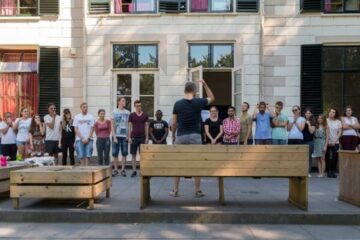
This July, a group of secondary students from our school took a decisive step toward understanding what it truly means to be part of the European project. As participants in Eudemos, an Erasmus+ initiative that connects schools across Italy, Portugal, Greece, Poland and Spain, our students travelled to Brussels to meet their European peers and explore the institutions that shape the continent’s political landscape.
The trip marked the culmination of months of online collaboration. Throughout the academic year, students had been working together on shared projects, exchanging ideas and perspectives through virtual platforms. One of the highlights was a COIL (Collaborative Online International Learning) project with a partner school in Greece, in which students compared cultural traditions, daily customs and social values. For many, it was their first opportunity to engage directly with young people from another country in an academic context—an experience that broadened their worldview and fostered genuine intercultural curiosity.
Brussels: A Classroom Without Walls
Arriving in Brussels offered the students something that no textbook could: a tangible encounter with the heart of European democracy. The group visited the European Commission, gaining insight into how proposals take shape and how policy becomes reality for millions of Europeans. At the European Parliament, students stood in the hemicycle where debates on climate, migration or digital policy unfold—issues they recognised from their own classrooms, suddenly made real and immediate.
The visit to the House of European History and the museum connected to the EU institutions provided historical context, showing the long and sometimes fragile path that led to the Europe we know today. For many students, these visits enriched their understanding of why cooperation matters and why dialogue remains at the core of the European project.
Outside of the institutional visits, students also had the chance to discover the cultural life of Brussels. Sampling traditional Belgian dishes, exploring the city’s streets and interacting informally with peers from other countries helped turn the trip into a memorable blend of learning and cultural immersion.
Beyond the Trip: Building European Identity
While July’s journey to Brussels was the emotional highlight of the year, the broader Eudemos project has offered students a sustained experience in international collaboration. For teenagers in compulsory secondary education, being part of such a project strengthens essential skills: communication, teamwork, digital collaboration and critical thinking. More importantly, it nurtures a sense of belonging to a wider European community—a feeling that becomes stronger when they can step inside the institutions that defend democracy and shared values.
As one participating teacher remarked, “Projects like Eudemos don’t just teach students about Europe—they let students experience Europe.”
For many of our students, this project has opened doors: to other languages, other cultures, and the understanding that they are active citizens of a union that values cooperation over division. And for a generation growing up in times of change, initiatives like Erasmus+ remain an invaluable bridge between education and the shared future of Europe.
[By Carlos Bonete Vizcaíno]